 Uganda
 Congo DR
Analysing Team Form and Market Implications
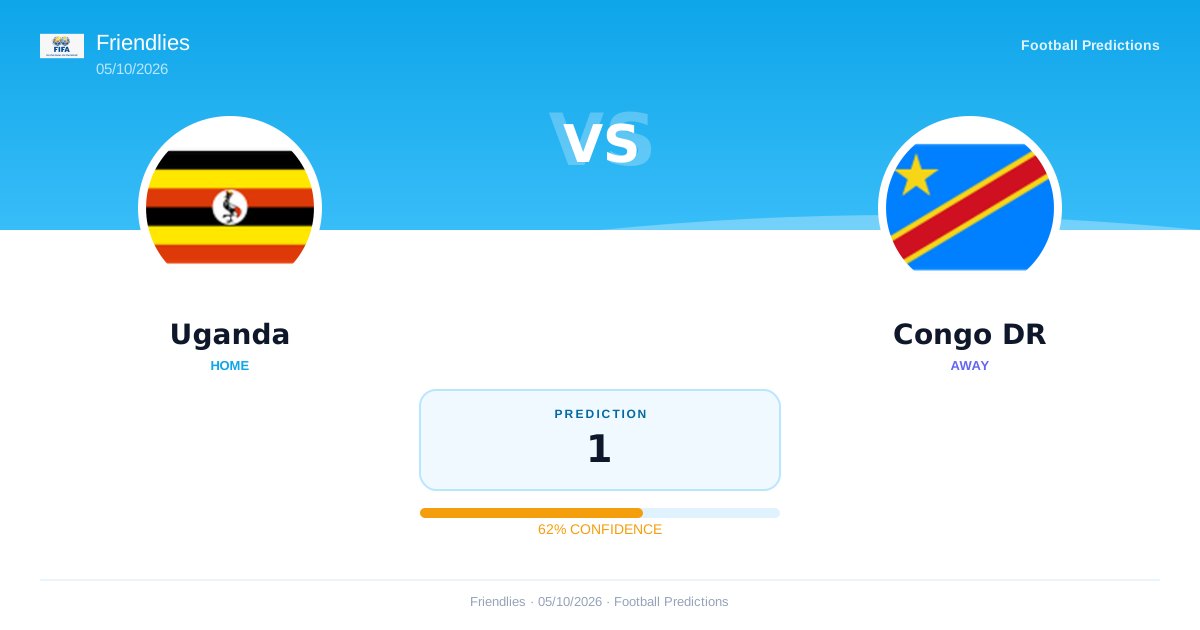
Although no recent form data is available for either team, the predicted model probabilities suggest Uganda is slightly favoured. With Uganda's expected goals at 1.51, they are forecasted to have a more potent attack in this friendly. This can often indicate a strong chance of success, especially when combined with home advantage. Despite the lack of recent match results, the model assigns Uganda a 48% win probability. For Congo DR, their predicted 0.97 expected goals reflect a more cautious approach, potentially limiting their attacking opportunities. Without tangible form data, bettors must rely on these projections to assess potential outcomes. The market currently prices Uganda's win at odds of 2.08, translating to an implied probability of around 48%. This aligns closely with the model's prediction, suggesting that bookmakers have priced Uganda correctly. However, the absence of recent form could mean that underlying factors, such as player fitness or tactical changes, are not fully captured. In the absence of concrete data, bettors should also consider external factors such as team morale or any potential strategic changes, which could influence the outcome.
In-Depth Market Analysis
The primary market of interest here is the match result (1X2), where Uganda is given a 48% probability of winning by the model, compared to an implied probability from odds at 2.08, which is approximately 48%. This lacks a significant edge, indicating the market is aligned with the model's assessment. The draw is priced at odds suggesting a 34% implied probability, while the model offers a 29% projection, indicating slight overvaluation by the market. In the Over/Under markets, the probability for over 2.5 goals is 45% with odds translating to an implied probability slightly higher, suggesting this market might be overvalued. The BTTS market at 48% is well aligned with the implied odds from available markets, suggesting no substantial edge. For a safer approach, considering a Double Chance bet or Draw No Bet on Uganda might provide a more risk-adjusted option without deviating from Uganda's potential strengths. However, the lack of conclusive data means any market play should be approached with caution, acknowledging the inherent uncertainties present in friendly matches.
Evaluating Risk and Maintaining Discipline
The greatest risk to the Uganda win bet is the lack of recent form data, which means our model's 48% win probability is based on historical averages and not current team dynamics. Without concrete match data, there's a risk that key players could be out of form, affecting Uganda's predicted offensive strength of 1.51 expected goals. Another scenario that could jeopardise the value pick is if Congo DR employs a highly defensive strategy, potentially nullifying Uganda's home advantage. Additionally, if Uganda's defensive capabilities are weaker than anticipated, Congo DR's modest 0.97 expected goals could still find the net, altering the match's balance. For disciplined bankroll management, this pick would lose its appeal should Uganda's odds shorten significantly, decreasing its value edge. Bettors are advised to re-evaluate their position if the odds move considerably closer to an implied probability matching the model's 48%, as this would erode the current 10% value edge.
Final Betting Verdict
The disciplined approach suggests backing Uganda to win at odds of 2.08, given the model's 48% probability aligns with the market but offers slightly better value considering external conditions like home advantage. This bet holds a value edge of 10 percentage points when assessed against the implied probability of their success. A safer alternative is the Double Chance on Uganda, reducing risk by covering the draw, although at lower odds. The primary risk remains the absence of form data, leaving predictions heavily reliant on model projections that may not capture recent tactical shifts or player conditions. In conclusion, while the Uganda win bet appears attractive, bettors should remain aware of the potential for unexpected outcomes given the limited data context.